
Disclosure: If you buy something via our link, we may earn a commission with no additional expense to you. As an Amazon Associate, I earn from qualifying purchases. Learn more

Ranking The Best from 80+ Computerized Telescopes

Rank & ratings last updated by Zane Landers on

I know most beginner astronomers are drawn to computerized GoTo telescopes for their many advantages, like requiring less (though not zero, contrary to popular belief) knowledge about the night sky and the ability to automatically move the telescope and track objects hands-free with the push of a button, inducing fewer vibrations than manual pushing.

However, in my opinion, computerized telescopes are not the best for everyone and are also more expensive for a given aperture size. The money spent on getting a computerized feature could instead go into simply purchasing a larger and more powerful manual telescope (like a dobsonian telescope) or even accessories. The GoTo/PushTo system also adds weight and takes longer to set up each time. Whether these tradeoffs are worthwhile is up to you.

That being said, very large telescopes (often costing $2000+) can outright require tracking (and, by extension, GoTo) to be used comfortably.

A few other cases where I can see the need for Go-To scopes are observatories and star parties, where we need to reliably find an object to show it off on schedule to a group of people. Also for specific astronomical events like occultations, transits, and eclipses, we need the tracking to keep us pointed at that obscure object so that we don’t miss anything. And, of course, there is astrophotography, where tracking is an absolute necessity. But in all of these use cases, what I find interesting is that they’re not strongly overlapping with the interests of a beginner astronomer who might have a budget less than $1000.

These telescopes are offered in either the fully computerized "GoTo" or partially computerized "PushTo" configurations:

Most of the GoTo telescopes that I had the chance to use in my early days of hobby came with the caveat of being unable to be aimed manually, either at all or without disrupting their GoTo system's tracking and pointing accuracy. But I can see that this is finally changing with the advent of new dual-encoder systems that allow seamless computerized and manual pointing abilities. I can move such newer GoTo telescopes manually without ruining the GoTo alignment.

Celestron's Astro-Fi/NexStar/NexStar Evolution, Sky-Watcher's SynScan/Virtuoso/AZ-GTi are some of the popular Go-To telescope series.

PushTo telescopes use encoders or our smartphones to compute where the telescope is aimed in the sky and then offer directions on where to manually push the telescope to get to our target in the sky. Celestron's StarSense Explorer series is the only PushTo telescope series you might encounter these days.

Category: Less than $400 Computerized Telescopes

Being the starting price range of computerized scopes, almost all of the telescopes in this price category have such small apertures that they tend to be severely limited in target options, to the point that the computerized mounting is of questionable usefulness to begin with. The views you get with most of these telescopes would be similar to those offered by manual scopes in the $200 price range and would be constrained to the Moon, planets, and the brightest deep-sky targets—all of which are relatively easy to locate manually.
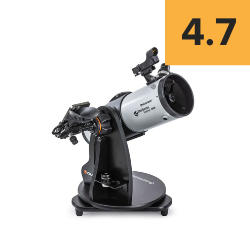
Celestron StarSense Explorer 114mm Tabletop Dobsonian
The Celestron StarSense Explorer 114AZ's 4.5" f/4 optics provide a tremendously wide field, making it even easier to observe deep-sky objects when combined with the StarSense Explorer app that uses your smartphone to aid in finding targets. With a good high-power eyepiece and Barlow lens, it's no slouch on the Moon and planets either, able to show the Cassini Division in Saturn's rings and even some detail on Mars.
Best GoTo Under $400
Sky-Watcher StarTravel 80 AZ-GTe Refractor GoTo
Rank 2
3.9/5
The lightweight and portable design of the AZ-GTe mount makes for a great pairing with this wide-field, short-tubed 80mm f/5 refractor. The included accessories are great, too. However, considering the high price tag and the huge amount of chromatic aberration inherent in a cheap, fast refractor, we’re not sure who this telescope is intended to appeal to.
Rank 3
3.7/5
The StarSense Explorer LT 80AZ Refractor has decent optics and comes with a pair of quality eyepieces included. It's also very easy to aim, thanks to Celestron’s StarSense Explorer Technology. However, due to its pitifully small 80 mm aperture, there are probably only a dozen practical targets where the StarSense Explorer app might be of any benefit.
National Geographic NG70mm Refractor GoTo
Rank 4
3.5/5
Celestron 80 LCM Refractor GoTo
Rank 5
2.2/5
The 80 LCM has mediocre accessories and a very low-quality mount. We would recommend steering clear of this telescope.
Rank 6
1.9/5
The Celestron 114 LCM’s Bird-Jones optical design and lousy mounting make it a spectacularly bad choice for beginners and experienced users alike, delivering mushy views on a wobbly and easily-broken computerized mount with poor accuracy.

Category: $400 - $600 Computerized Telescopes

A 150 mm aperture is pretty nice for being computerized, and a 130 mm aperture is what I'd call a fair aperture for the computerized feature to be useful. But at the same time, many of the low-quality scopes in this price range have weaker tripods and plastic or imprecise gears, lower-quality or fewer accessories, and tend to consume more power.
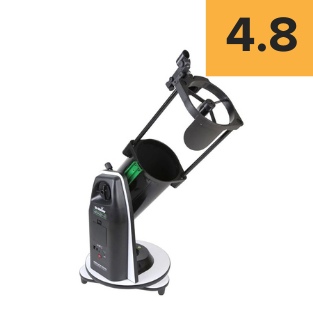
Sky-Watcher Virtuoso GTi 150 Tabletop GoTo Dobsonian
With quality optics, well-made included eyepieces, and the ability to be used manually even while the mount’s electronics are powered on, I find it hard to argue against this fabulous instrument, especially at a price on par with most 150mm manual telescopes. Its portability, value for the money, wider field of view, and well-designed GoTo mounting that can be controlled via our smartphones make it one of the best deals in astronomy gear there is.

The Sky-Watcher Virtuoso GTi 150P is one of the main telescopes I recommend and is the second most purchased through our recommendations, just behind the manually operated Apertura AD8. It works best when placed atop a short, elevated surface like a bar stool or milk crate.

Rank 2
4.6/5
The Celestron StarSense Explorer 150mm Dobsonian, to no surprise, uses standard 150mm f/5 optics used by most other 150mm telescopes, including the above-ranked Sky-Watcher Virtuoso GTi 150P. Considering that the fully computerized Virtuoso GTi 150P is quite a bit less expensive, I can’t really think of a good reason to go with the StarSense Explorer 150 mm Dobsonian. Still, it certainly would deliver excellent views and is well aided by the easy-to-use StarSense Explorer smartphone app and technology.
Rank 3
4.6/5
The Virtuoso GTi 130P is a tremendously capable little telescope, with my only complaint being that the larger aperture version, the Virtuoso GTi 150P, is available for just a bit more. The 150P provides 40% more light gathering and 20% more resolving power than the 130P. The Sky-Watcher’s collapsible tube technology helps the scope be fitted into a backpack or a large backpack when it’s disassembled. But this collapsible tube does need a homemade foam or paper shroud to keep stray light out; if I use the scope under light-polluted conditions without one, the views get washed out in brown, which the 150P also suffers from.
Best Value Non-Dobsonian GoTo
Rank 4
4.4/5
The tripod-mounted and phone-controlled Astro-Fi 130 reflector has the same optics and extremely similar features and accessories to the above-mentioned Sky-Watcher Virtuoso GTi 130P. However, unlike the Astro-Fi, the GTi 130P has a collapsible tube and can be aimed manually. The Astro Fi adds a 2” focuser and tripod, but as far as I'm concerned, these aren't really necessary nor worth the bump up in price.

The use of a 2" focuser and eyepiece can bring the AstroFi 130's field of view up to nearly 4 degrees from the GTi 130P's already-wide 2.5 degrees, which is even greater for deep-sky observing with the AstroFi 130. But unfortunately, this inexpensive 2" rack-and-pinion focuser is hard to focus at high power.

Though the scope is a bit of a battery guzzler, it has an easy-to-use interface and a solid mount that’s easy for beginners and enjoyable for experienced users to get the hang of.

You may disregard the Astro-Fi 130's low Amazon ratings, which happened due to numerous bugs with the initial units’ software. I used to hesitate to recommend it too. But these issues have since been remedied and should not be of concern to new buyers.

Rank 5
4.3/5
The StarSense Explorer DX 130AZ uses the same optical tube as the above-mentioned Astro-Fi 130 and Virtuoso GTi 130P. But unlike the fully computerized Celestron Astro Fi and Sky-Watcher Virtuoso GTi GoTo systems, the DX 130AZ is controlled via Celestron’s smartphone-aided StarSense Explorer tech. This system assists in getting to the targets by showing which direction to push the telescope manually, but it doesn't track them once they drift across the sky. GoTo systems are vastly preferable to the simple Push-To system of the DX 130AZ, but these are cheaper to own.
Rank 6
4.3/5
The Celestron StarSense Explorer 130mm Dobsonian shares its optics with the previously mentioned Celestron DX 130, Astro Fi 130, and Sky-Watcher Virtuoso 130P. But unlike the DX 130AZ and Astro-Fi 130, it features only a 1.25” focuser, and a cheap plastic rack-and-pinion one at that. The DX130 is more versatile with its 2” focuser, while you could also get the Sky-Watcher Virtuoso GTi 130mm or Celestron Astro Fi 130 with full motorized GoTo and tracking for around the same price as the StarSense 130mm tabletop.
Best GoTo Refractor Under $600
Rank 7
4.2/5
The Astro-Fi 102 boasts 4” (102mm) Maksutov-Cassegrain optics with sharp views in a very compact form, mounted atop a full-sized tripod and controlled via your smartphone/tablet using the SkyPortal or SkySafari Pro app. But due to the Astro-Fi 102’s small aperture and long 1325 mm focal length, we aren't able to view much in the way of deep-sky objects, and it feels like it's primarily optimized for lunar and planetary viewing. The brightest nebulae and open star clusters don't fit in its field of view, and the scope's aperture is too small to view most planetary nebulae, globular clusters, and galaxies in detail. However, the setup is very portable, and Maksutov-type telescopes don’t need collimation, which may justify their worth despite the price tag.
Rank 8
4/5
For the price tag big enough to obtain a larger and fully computerized instrument, this Celestron model is not the most economically justifiable scope.
Rank 9
4/5
Like the other Astro-Fi telescopes, the Astro-Fi 90 is able to be completely controlled by your smartphone and is not a bad telescope. The Astro-Fi 90 is lower on our list due to its small aperture and long focal length, which limit its target options to planets and bright stars, for which the computerized mounting is of questionable usefulness to begin with.
Rank 10
3.8/5
The NexStar 90SLT is not a bad scope and features an acceptable mount and accessories along with great optics. It is a 90mm f/14 Maksutov—the same optical tube as Celestron’s C90, designed to emulate the famed and mechanically superior Questar 3.5. The SLT (Star Locating Telescope) mount is designed to be very lightweight and inexpensive, but it’s so lightweight that it’s easily bumped or knocked over. However, it carries the 90SLT optical tube fine and has no issues with vibrations. Setting up and aligning the mount is time-consuming and, quite frankly, overkill for a small instrument that’s almost exclusively useful for the Moon and planets. There’s really not much of a point in purchasing it. Those interested in a computerized telescope should really pursue something with more aperture, and those interested in a quick “grab n’ go” instrument should consider a tabletop telescope of some kind.

Category: $600 - $850 Computerized Telescopes

Computerized telescopes in this price range are mostly tripod-mounted 4-6” telescopes, except for the 8" dobsonian and 6" tabletop dobsonian offerings from Celestron's StarSense Explorer series. Many of these are pretty good optically, but I don’t see most of these telescopes benefiting that much from GoTo except mostly gaining performance from the motorized tracking of GoTo systems.
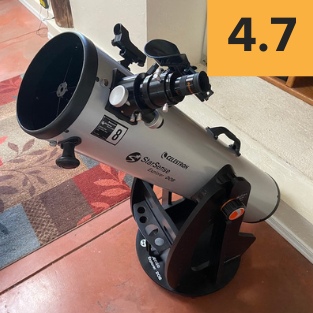
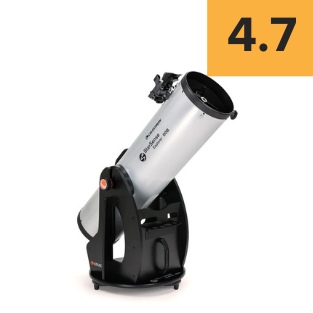
Celestron StarSense Explorer Dobsonian 8" Telescope
Any 8” Dobsonian puts up excellent views, and the StarSense Explorer 8” throughout the period that I used it was no exception. In addition to the extremely easy-to-use StarSense Explorer technology, what separates the Celestron StarSense Explorer 8” Dobsonian from other 8” Dobsonians is its lightweight Dobsonian base. The downsides are its price and lack of accessories, which are why we prefer the non-computerized Apertura AD8 over this scope.
Sky-Watcher 102 mm Skymax AZ-GTi Maksutov GoTo
Rank 2
4.4/5
While expensive, the 102mm Skymax Maksutov pairs wonderfully with the AZ-GTi. Moving the mount manually won’t disrupt tracking or slewing accuracy, thanks to the GTi’s Freedom Find encoders. The optics are fabulous, the cooldown time is negligible, and the included accessory set is plenty good to start with. The mount and tripod are remarkably compact, and we can even convert the GTi into an equatorial star tracker. However, this small Maksutov-Cassegrain is outperformed by the larger Dobsonians and Schmidt-Cassegrains in our list. Notably, the Celestron Astro-Fi 102 is essentially identical, apart from the lack of manual adjustments, at a much lower price.
Celestron StarSense Explorer DX 5” SCT PushTo
Rank 3
4.2/5
Using Celestron’s C5 SCT optical tube atop the StarSense Explorer mount, the StarSense Explorer DX 5” doesn’t have views any better than a typical 130 mm reflector model. In fact, it’s quite a bit inferior in performance. But it is slightly steadier and more compact thanks to the C5 optical tube’s Schmidt-Cassegrain design. However, it lacks motorized tracking like most similarly sized scopes in this price range. We would probably recommend one of those telescopes—or a Dobsonian—instead. However, the C5 is somewhat useful for terrestrial viewing and is a little bit better suited for high-magnification views.
Rank 4
4/5
The NexStar 4SE is sturdy, well-mounted, and features great optics. While the higher-quality gearing in the SE mount is nice, the main advertised features of the 4SE, such as the flip mirror and built-in wedge, are basically useless gimmicks, and you’d be better off with a larger computerized scope or with the Astro-Fi 102.
Rank 5
4/5
The NexStar 127SLT has great optics, but the mount is undersized, and the field of view of the telescope is quite narrow thanks to its long focal ratio. The scope is inferior in performance to the much cheaper 130mm or 150mm reflectors/Dobsonians that are available, such as the Astro Fi 130 or Virtuoso GTi telescopes.
Sky-Watcher StarTravel 102 AZ-GTe
Rank 6
3.9/5
As with the smaller 80mm model, the huge amount of chromatic aberration and the stripped-down nature of the GTe mount (lacking any ability to be moved manually) make this scope and mount combination a rather unappealing pick at any price range, much less the outrageously high one it commands.
Rank 7
3.8/5
The NexStar 130SLT is a decent telescope, but its tripod legs are not the best. For less money, we could get the Astro-Fi 130, which has the same views but is more stable and easier to align and control.
Rank 8
3.3/5
The NexStar 102SLT is under-mounted, its dew shield is too short, it can’t balance with heavy eyepieces, and there’s quite a bit of chromatic aberration thanks to its rather fast focal ratio. We’d recommend you steer clear.

Category: $850 - $1200 Computerized Telescopes

Computerized telescopes above $1000 offer large enough apertures that they can actually show us stuff that’s difficult to find, and motorized options begin to offer some form of imaging capability, albeit not particularly good quality and often lacking the ability to autoguide the mount.
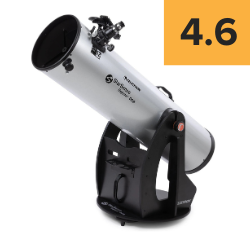
StarSense Explorer 10" Dobsonian Telescope
While not as well-accessorized as our most recommended and best-valued 10" manual Dobsonians, the Apertura AD10, the StarSense Explorer 10″ model is lightweight, and the StarSense Explorer technology is great if you're new to finding deep-sky objects. However, be prepared to spend quite a few extra bucks on some accessories for your new scope, as only a single eyepiece is included and the focuser is a rather basic single-speed unit.
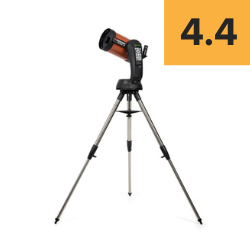
Celestron NexStar 6SE Computerized Telescope
The Celestron NexStar 6SE is the smallest of Celestron’s fully computerized options to actually have enough aperture for the GoTo to make sense. The 6SE has a long focal ratio of f/10 and a resulting 1500mm focal length, which gives it a narrower field of view than competing 6" Dobsonian telescopes, but it does make it easier to do planetary astrophotography with the addition of a 2x Barlow lens. It can also do a decent job for viewing deep-sky objects (under a dark sky) or even imaging them (with a HyperStar conversion).
The included features and accessories aren't much, but you can upgrade the 6SE with a WiFi adapter and add some aftermarket eyepieces. The 6SE is also remarkably compact. Overall, a very good choice for the beginner or experienced astronomer.
Sky-Watcher 127 mm Skymax AZ-GTi Mak GoTo
Rank 3
4.3/5
As with the 102mm Skymax Maksutov, this mount and scope combination is a great “grab n’ go” instrument—but with a high price tag and minuscule gains over a 102mm Maksutov thanks to the Synta Maksutovs’ stopped-down 120mm of actual aperture. The only things you really gain are price and cool-down time for the optics on cold nights.
Rank 4
4.1/5
The Celestron NexStar 5SE (“Special Edition”) has a heritage going back to the original Celestron C5, introduced in the early 1970s. It boasts a full 5” of aperture with StarBright multi-coatings and water-white corrector lens glass for maximum light-gathering capability.
However, being an f/10 Schmidt-Cassegrain means its field of view is rather narrow. Unlike 6SE or larger Schmidt-Cassegrains, we can’t use a standard f/6.3 reducer or 2” diagonal and eyepieces to increase the field of view, as the 5SE’s baffle tube will vignette too much for either to work effectively.
Also, the 5SE’s rather large secondary mirror—covering 37.8% of the scope’s diameter—reduces contrast quite a bit and has a slight impact on light-gathering ability. Celestron NexStar 6SE, the larger sibling, is way better than the 5SE for the money we pay.
Explore FirstLight 127mm Mak-Cassegrain with EXOS2GT GoTo
Rank 5
3.8/5
While the Explore Scientific 127mm Maksutov-Cassegrain is nice, the Exos-2GT mount is hardly advanced or convenient and really has no place being used with this telescope, though it's at least plenty sturdy.
Rank 6
3/5
Celestron's overpriced self-aligning version of the NexStar 130SLT, which rarely works as designed. We do not recommend this telescope.

Category: $1200 - $2400 Computerized Telescopes

Celestron StarSense Explorer 12" Dobsonian Telescope
The Celestron StarSense Explorer 12” Dobsonian, as with the smaller 8” and 10” versions, isn’t as well-equipped as its GSO 12” counterpart sold by Apertura but features a considerably lighter base and built-in handles, which considerably aid portability, alongside the Celestron StarSense Explorer technology to help you navigate around the night sky. This is a beast of a scope for sure, but the views at the eyepiece are more than worth it.
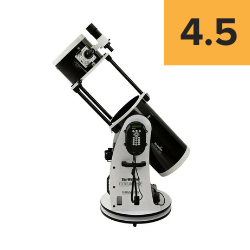
Sky-Watcher 10" Flextube SynScan 250P GoTo Collapsible Dobsonian Telescope
The Sky-Watcher 8” and 10" FlexTube Collapsible GoTos can be used both manually and with its GoTo system activated, with neither interfering with the other. This allows us to save power by nudging the scope to the approximate area of sky we’d like to observe, then using the GoTo to fine-tune until we’re on target.

The FlexTube design does indeed reduce the tube length slightly to make storage and transport a bit less of a hassle. The base can also be easily disassembled without tools to pack flat into a trunk or truck bed, so portability isn’t too much of a problem with either the 8" or 10". But the setup time can get kind of long if you dismantle the base. The 10” FlexTube is similar in form factor and operation to the 8” FlexTube model, but with significantly brighter images and more resolving power.

The open tube necessitates a shroud of some sort to keep light out of the tube, as well as mitigate dew, which you can either purchase or sew yourself.
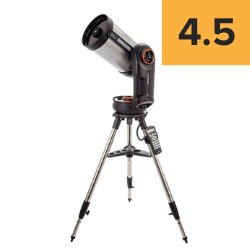
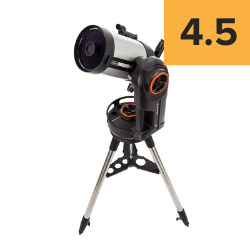
Celestron 8" NexStar Evolution Computerized Telescope
The latest version of Celestron's flagship C8 introduced in 1970, the NexStar Evolution 8 features sharp Schmidt-Cassegrain optics in a compact form factor and a sturdy tripod (unlike its cheaper cousin, the 8SE). However, the field of view is narrower than that of a typical 8" Dobsonian, and in practice the Evolution 8 takes up similar floor space—though if you have a compact car, for instance, the Evolution 8 might make a lot more sense than a typical 8" Dob.

The Evolution mount and tripod feature GoTo that is controlled either with the provided hand controller or a smartphone app such as SkySafari or Celestron’s free SkyPortal app. You can also unlock the clutches on the mount and aim it manually, but not with the scope powered on.

The Evolution mount’s built-in WiFi is already a great feature, but it’s complemented with a built-in lithium battery that is rechargeable, runs the scope for a few nights straight, and will last about a decade before needing replacement.

Celestron NexStar Evolution 6" Schmidt-Cassegrain Telescope
The NexStar Evolution 6 features substantial improvements over its cheaper cousin, the Celestron NexStar 6SE, with a more modernized mount that allows operation via SkySafari and other apps, as well as a built-in battery. You can also aim the Evolution manually when it's powered off. It also has better gearing, a slightly simpler setup, and comes with two eyepieces out of the box, as opposed to the 6SE’s single 25mm Plossl. However, the views are identical to those through the 6SE, and the included extra eyepiece isn't anything to write home about at this price point.
Rank 4
4.1/5
The Celestron NexStar 8SE features Celestron's excellent C8 XLT optical tube, but the NexStar tripod itself has a hard time with the weight of the C8, and performance is in practice no better than a typical 8" Dobsonian. The 8SE’s mount is less than ideal to carry the 8" optical tube due to its rather small tripod legs and lightweight single-arm fork design. The field of view is starting to get uncomfortably narrow too (particularly when used without a focal reducer or 2” eyepieces).
We’d recommend stepping up to the 8” NexStar Evolution, Advanced VX, or CPC 800 GPS model instead if you must have an 8” Schmidt-Cassegrain.
Rank 5
4/5
The C6 optical tube is best with either a HyperStar unit or an f/6.3 reducer for deep-sky astrophotography, but is a reasonable scope to start with and works well on the Advanced VX mount. However, setting up this relatively small scope on a clunky, big, and complicated mount for visual use is simply overkill when you could just get the Evolution 6 or NexStar 6SE instead.
Rank 6
3.9/5
The Advanced VX 8” could be an acceptable platform for learning astrophotography, but it is quite a complicated rig to set up and assemble and arguably overkill for visual use. The 8” optical tube is also pushing the limits of the mount’s capabilities, and thus it can be a bit frustrating to get consistently sharp results with long exposures.
Rank 7
3.8/5
The 6” Advanced VX Newtonian is easier to get the hang of using—especially for astrophotography—than even its 8” model, due to its lighter weight and shorter tube, but it lacks the 2” focuser of the 8” model (practically required with most camera sensors to achieve sharp images across the frame) or as much aperture for visual astronomy.
Rank 8
3.8/5
The 6” Advanced VX Refractor suffers from some chromatic aberration and is certainly not the astrophotography-ready platform that marketing material might suggest. It’s a great choice for those who want a big refractor, though you might want to ponder what it is that’s so appealing about such a rig before purchasing. It's certainly still a nice telescope, but there are more practical options for the price.

Category: Telescopes in the ~$2,400-$3,600 range

Sky-Watcher 12" Flextube SynScan GoTo Collapsible Dobsonian
2nd Best Value GoTo Dobsonian
Sky-Watcher 12" Flextube Dobsonian GoTo
The 12” Flextube isn’t as compact as a true truss model, but for many people, the collapsible tube is all they need to fit it into a vehicle or storage space. Setting up the GoTo 12” Flextube is almost identical to the manual version; the FlexTube Dobsonian can still be used manually, and there isn’t much of a price difference between the two. Having GoTo at this size is beneficial not just for the tracking but also for keeping your targets in the field of view with such a big scope.

Due to Sky-Watcher's inventive FlexTube system, the 12" FlexTube GoTo has a significant amount of light-gathering capacity but still retains some degree of portability and can be moved and set up by one person.

As with all open-tubed telescopes, some kind of shroud is needed to keep light and moisture out of the telescope tube and preserve contrast at the eyepiece, especially under light-polluted skies, but this is not a huge expense and is easy to make yourself, too.

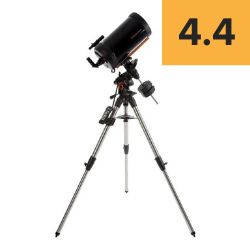
Celestron Advanced VX 9.25" Schmidt-Cassegrain Telescope
The Advanced VX is not up to the task of supporting the C9.25 optical tube for deep-sky astrophotography, of course, but it makes for a much less intimidating option than the massive Evolution or CPC mounts offered with the C9.25; the whole setup fits in a sports car, and you can swap the C9.25 out for a smaller astrograph more in line with the Advanced VX’s payload capacity if you wish.
Rank 3
4.4/5
The EdgeHD optics upgrade to the NexStar Evolution 8 improves cooldown time and sharpness towards the edges of the field of view at low magnification, while Celestron's StarSense technology also speeds up setup of the already simple and portable Evolution mount. We'd say that the expense of better eyepieces probably improves the view through the regular Evolution 8 more, but the choice is yours.
Rank 4
4.3/5
An imaging-only telescope, the Celestron RASA 800 offers a wide field with its mere 400mm focal length at the super-fast speed of f/2. The Advanced VX mount makes for a decent pairing with this instrument and a good one-shot color CMOS or CCD camera for deep-sky astrophotography, though it’s not the most accurate or well-equipped mount for the job.
Rank 5
4.3/5
The 8” Advanced VX Schmidt-Cassegrain makes for a surprisingly portable setup and is especially good for planetary imaging. However, the Advanced VX is simply not up to the task of supporting the 8” Schmidt-Cassegrain optical tube for deep-sky astrophotography, nor is a C8 an ideal first astrophotography scope.
Rank 6
4.3/5
The 9.25” NexStar Evolution features the C9.25 XLT optical tube mounted atop the Evolution mount head, but with a massive tripod borrowed from the Celestron CPC telescopes. The Evolution mount head is not really up to the task of holding the C9.25 when I start adding a 2” diagonal into the mix (which is somewhat mandatory), and the CPC tripod is utterly massive. The 9.25” optical tube has a slightly different optical configuration than Celestron’s other Schmidt-Cassegrain telescopes. This results in it being easier to collimate and having sharper images. However, the 2350mm focal length of the C9.25 tube results in a field of view that feels rather claustrophobic even with 2” low-power eyepieces, and thus it’s best for viewing the Moon, planets, and small deep-sky objects such as globular clusters and planetary nebulae.
Rank 7
4.3/5
The CPC 9.25 is bulkier and heavier than the NexStar Evolution 9.25” but is significantly more sturdy. The CPC fork mount is simpler to set up than an equatorially-mounted configuration of the C9.25 XLT optical tube, though it’s of course a lot heavier and less versatile. You should probably consider an equatorial mount for the C9.25 XLT regardless of what you plan to do with it, but of the alt-azimuth C9.25 and mount configurations, the CPC is definitely the better choice.
Rank 8
4.1/5
The CGEM II is sufficient enough to allow for acceptable deep-sky images with the C8 XLT optical tube and an f/6.3 reducer and is rock solid for imaging with a Hyperstar f/2 conversion. It’s also only slightly bulkier than the Advanced VX, making it ideal for planetary imaging or visual observation too, though with few advantages over the Advanced VX or NexStar Evolution mounts for either purpose.
Rank 8
4.1/5
7” Maksutovs are specialty products, with long cooldown times and almost exclusively useful for lunar and planetary viewing or imaging, but if you’re willing to put up with the limitations of the Advanced VX 700, it essentially provides the same capabilities and focal length as the C9.25 with slightly lower maintenance and more tolerant focusing. However, you’re losing quite a bit of aperture, and the cooldown time can be a nuisance if you don’t rig up some kind of fan system.
Rank 9
4.1/5
The Advanced VX 8” EdgeHD provides little in the way of advantages over the regular C8 XLT for visual astronomy or planetary imaging, and the Advanced VX is insufficient to carry the C8 optical tube for long-exposure deep-sky imaging unless you use the scope at f/2 with a HyperStar conversion, which costs a lot more than just buying the 8” RASA instead.
Rank 10
4.1/5
The CPC 800 is a little less fancy than the 8” NexStar Evolution but comes on a beefier mount and can be used for astrophotography on an equatorial wedge (sold separately).
Celestron CPC 800 EdgeHD SCT GoTo
Rank 11
4/5
While technically usable for deep-sky astrophotography on a wedge, there's otherwise little point in the CPC 800 EdgeHD compared to the regular CPC 800, and the EdgeHD NexStar Evolution 8 offers GPS via your phone as well as automatic alignment, which the CPC does not have.

Category: $3600+ Computerized Telescopes
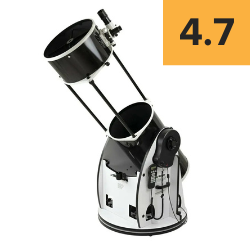
Sky-Watcher 16" Flextube SynScan 400P GoTo Collapsible Dobsonian Telescope
Sky-Watcher Flextube SynScan Collapsible 14″/16″ Dobsonian GoTos

Available solely in GoTo configurations, the 14” and 16” FlexTube models have the same great features as Sky-Watcher’s smaller GoTo Dobsonians, with the ability to be aimed manually thanks to FreedomFind encoders, and the GoTo system is easily operated via your smartphone/tablet. The 14”/16” FlexTubes have even more light gathering than the 12” model, with the bonus of a dual-speed 2” Crayford focuser and a base that can be packed fully flat for better transport/storage.


Even when collapsed, the 14” and 16” FlexTubes are huge compared to a true truss tube scope of its size. When collapsed, it’d easily fill a typical car and is a far cry from the portable form factor of an actual truss Dobsonian design when dismantled. The 14” is easier to transport and store compared to the 16”, though. The GoTo base is also extremely heavy/bulky even when dismantled into its separate pieces.
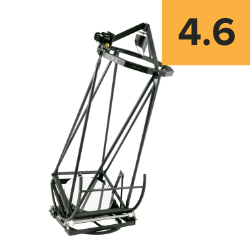
A 14” Dobsonian has even brighter images than a 12″—though side by side, a 36% gain in light grasp doesn’t seem that impressive, it’s triple the light-gathering ability of an 8” (compared to double that of an 8” with 12” of aperture). But the usual considerations of a shroud and additional eyepieces apply here too.
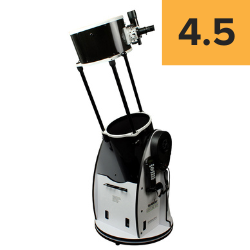
Hubble Optics Premium Ultra Light Dobsonian Telescope
Hubble 14″/16″/18″/20″ GoTo Dobsonians
All of the Hubble Optics Dobsonians are fairly compact and portable for their size, and they deliver unmatched performance for the price. A savvy user can get one working in relatively short order. The Hubble Optics UL14 is probably the most mechanically sound model of the Hubble Optics lineup, while the 20″ Dobsonian is compact enough to fit in most vehicles. However, you’ll need to DIY some upgrades and invest in at least a few premium eyepieces for these scopes to perform at their best.
Rank 3
4.5/5
The Celestron CGEM II makes for an ideal mount for the C11 XLT for visual astronomy and planetary imaging use, being much sturdier than the Advanced VX and more compact than the CPC or larger CGX mounts. Neither the scope nor CGEM II is ideal for deep-sky imaging, but the C11 XLT is a fabulous scope for the visual observer or planetary imager.
Rank 4
4.5/5
The Celestron CPC 1100 is the largest of the three CPC scopes and is the only alt-azimuth-mounted configuration offered for the C11 XLT optical tube. However, it is rather bulky and heavy, as the C11 is permanently attached to the heavy-duty fork mount, which can make storage and transport difficult.
Celestron 11″ CGX 1100 RASA GoTo
Rank 5
4.5/5
The Celestron 11” RASA is pushing the CGX somewhat for the most demanding imaging applications and can be a little much to get used to for those coming from smaller imaging setups, but it’s a fabulous research-grade option for quality deep-sky images—though at only 560 mm focal length, not all targets are going to be optimally framed.
Celestron 8″ CGX 800 RASA GoTo
Rank 6
4.5/5
The Celestron 8” RASA is a great astrophotography instrument, and the CGX mount is a rock-solid platform for imaging with it, enabling very long exposures with fewer limitations than a smaller and lower-quality mount option.
Rank 7
4.5/5
The Celestron CGX is more than adequate for astrophotography purposes with the EdgeHD 8” optical tube and is usable for a variety of imaging and visual tasks at f/2, f/7, or native f/10 or with a Barlow lens for a longer f/raito. However, the CGX is capable of supporting the larger C9.25 EdgeHD too.
Celestron 11″ CPC 1100 EdgeHD SCT GoTo
Rank 8
4.5/5
The Celestron EdgeHD optical configuration offers few perceptible advantages over the regular C11 XLT for visual use or planetary imaging, but the CPC fork mount is not exactly the best for deep-sky astrophotography, even when paired with a wedge and autoguiding. It also possesses the same extremely bulky and heavy frame as the regular CPC 1100 model, which may be uncomfortable for many users to set up or transport.
Celestron 9.25″ CGX 925 EdgeHD SCT GoTo
Rank 9
4.4/5
The regular Celestron C9.25 is not ideal for deep-sky astrophotography compared to the EdgeHD version, and the CGX mount is overkill with this scope for visual use. As such, there’s not much of a point in purchasing, though the CGX makes for a fine mount with plenty of capabilities.
Celestron 11″ CGX 1100 SCT GoTo
Rank 10
4.3/5
The Celestron CGX is a great mounting for the C11, featuring a better build than the older CGEM II design and with features that make it more astrophotography-friendly—though you’ll want to use a different telescope than the C11 for deep-sky imaging with the CGX.
Celestron 11″ CGX 1100 EdgeHD SCT GoTo
Rank 11
4.3/5
The Celestron CGX mount is more than enough to hold the C11 or EdgeHD 11 optical tubes for visual observation and decent enough for long-exposure deep-sky astrophotography, though a beefier and probably permanent mount would be more ideal for the job. The views through this scope are a delight too.
Rank 12
4.2/5
The regular Celestron C9.25 is not ideal for deep-sky astrophotography compared to the EdgeHD version, and the CGX mount is overkill with this scope for visual use. As such, there’s not much of a point in purchasing, though the CGX makes for a fine mount with plenty of capabilities.
Celestron 8″ CGX 800 SCT GoTo
Rank 13
4.2/5
The Celestron C8 XLT is extremely overmounted for visual use on the CGX while being sub-par for deep-sky astrophotography compared to the EdgeHD or RASA designs. As such, while there’s nothing inherently wrong with the scope, we do not recommend this combination as highly compared to those options.
Rank 14
4.1/5
The Celestron CGEM II mount isn’t much of an upgrade from the Advanced VX for imaging purposes, though it’s adequate and a little steadier with the 8” RASA. However, we would recommend springing for an EQ6Ri Pro or CGX mount instead if you can afford it.
Celestron 9.25″ CGEM II 925 SCT GoTo
Rank 15
4.1/5
The CGEM II is somewhat overkill for holding the C9.25 XLT for visual use while being completely insufficient for deep-sky astrophotography with such a big scope. However, it is a little steadier than the Advanced VX if you demand more rigorous requirements.
Celestron 8″ CGEM II 800 RASA GoTo
Rank 16
4.1/5
The Celestron CGEM II mount isn’t much of an upgrade from the Advanced VX for imaging purposes, though it’s adequate and a little steadier with the 8” RASA. However, we would recommend springing for an EQ6Ri Pro or CGX mount instead if you can afford it.
Rank 17Hubble 12″ GoTo Dobsonian4
Rank 18Celestron CPC 925 EdgeHD SCT GoTo4
Rank 19Celestron CGEM II 11″ EdgeHD4
Rank 20Celestron CGEM II 7″ Mak4
Rank 21Celestron CGEM II 9.25″ EdgeHD4
Rank 22Celestron CGX 7″ Mak4
Rank 23Celestron Advanced VX 9.25″ EdgeHD SCT GoTo3.7
Rank 24Celestron Advanced VX 11″ SCT3.5

Reasons Why I Often Recommend Manual Telescopes Over Computerized Ones

Except for the Celestron NexStar Evolution telescopes and a few other costlier telescopes, almost every computerized telescope requires a portable power supply, either a 12-volt lead-acid rechargeable DC battery or lithium-ion rechargeable batteries. Either adds cost to your scope and has to be hauled around. I’ve used AA batteries as backups in some telescopes, but they quickly guzzle them within a few observing sessions, and I found it to be expensive to continually replenish them. So, I’d advise you to budget at least $50 for a power supply.

GoTo technology has been around for three and a half decades now. Yet I see many computerized telescopes having an interface basically the same as it had 20 years ago, with a small hand controller with the processing abilities of a pocket calculator, a small LCD screen with calculator-like text, and many functional limitations. Most computerized scopes still have no internal clocks and require re-alignment if power is lost, even briefly.

However, newer models like SkyWatcher’s Virtuoso series and Celestron’s StarSense Explorer series, among many others, are exceptions.

Most computerized telescopes have an advertised feature that supposedly lets us quickly align their GoTo system by using any three bright sky objects or by simply pointing the scope north and leveling the scope with the horizon. But from my vast experience, neither works accurately, and most of the time, I end up having to align on two known bright stars. But for you to do this, you need to have a basic understanding of the motions of the sky and some bright stars to find in the sky.

I also experience occasional failures and weird behaviors requiring hours of troubleshooting—hours that could be spent looking through a manual telescope’s eyepiece instead.

If you ask me, star charts and observing books like Turn Left at Orion are much more interesting and engaging to read than the user manual of a Go-To telescope. Also, learning star hops in online forums is more interesting and engaging than consulting troubleshooting forums.

And it is indeed more fun to manually point a telescope, following star-hops to figure out where an object is in the sky. It’s more fun because it’s more engaging and it gives you something to do. By learning to find objects, you’re learning the night sky. You’re learning to navigate it, to go from place to place, to learn which objects are in the neighborhood.

However, the pros may outweigh the cons for you depending on your situation, and there’s absolutely no shame in owning a computerized instrument.

5 thoughts on “Ranking The Best from 80+ Computerized Telescopes”

  1. I own an old nexstar 4 . The hand control failed although the direction buttons still work. I have a large tripod, a full set of eyepieces and filters, and a sun filter. What can I purchase that would be reliable and utilize some of my old accessories. I would want to have minimal alignment or setup requirements.

  2. Thank you for this site. My brother and his family are going to moving into a new home in a secluded area where they should be surrounded by beautiful dark skies and nature, and I want to gift them a telescope as a housewarming. Honestly, I do not feel we have any future astronomers among the group, but I would like to give them something sturdy and amateur user friendly. I like the idea of giving them a “push to” or “go-to” telescope. I was looking at the Meade StarNavigator NG based on the Space.com site, but I see it is not a recommendation for you. Can you help me determine what I should be looking at given what I have shared, please? Thank you for your consideration

  3. Hello, I ordered the Sky-Watcher Virtuoso GTI 150P and am excitedly waiting for the same. What accessories do you suggest? This will be my first telescope and will be observing more from the backyard. Thinking of a simple step stool for the table to setup the telescope. Guessing eyepieces are the most importan accessory I need. No specific budget, looking for best value rather than lowest price or maximum performance. I wear glasses for short sight and will be with my 6y daughter who does not. Do eye pieces come with diopter adjustment like binoculars? Thinking of binoviewers for planetary watching so may be buying double the eyepieces. Lots of light pollution from street lights and neighbors so will likely need a shroud. What would you recommend? Thanks!

    • You don’t need a diopter adjustment or anything like that, just focus for your own eyesight. Binoviewers have diopters.

Comments are closed.